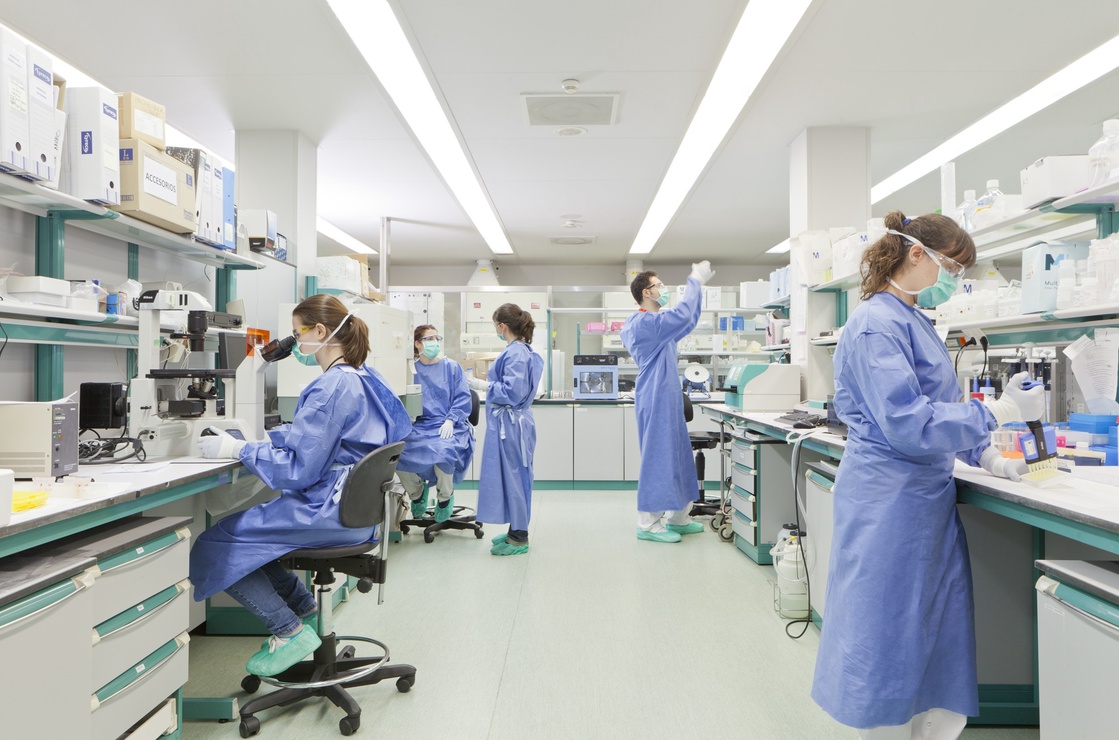
Established in 1995, IrsiCaixa is an internationally recognized biomedical research center at the forefront of infection and immunity research. Evolving from foundational discoveries in HIV to a broader mission across immunopathology, the institute currently hosts 12 collaborative research groups spanning six core strategic areas:
Team: 128 professionals dedicated to biomedical research and innovation.
Research Output & Impact: Over 1,200 scientific publications with more than 60,000 citations.
Active Grants & Translational Capacity: Over 140 active research projects across international and national programs.
Innovation & Tech Transfer: 14 patents filed and 2 spin-off companies successfully established (including AlbaJuna Therapeutics and AELIX Therapeutics).
Global Reach: Active collaborations with more than 40 international partner institutions worldwide.
3. State-of-the-Art Facilities & Core Platforms
IrsiCaixa is situated directly within the Germans Trias i Pujol University Hospital on the Can Ruti Biomedical Campus (one of 11 high-level health science institutions on campus). This location enables a uniquely integrated translational model linking laboratory researchers, healthcare professionals, clinical trials units, and patients.
Containment Infrastructure: Fully equipped Biosafety Level 2 (BSL-2) and high-containment Biosafety Level 3 (BSL-3) suites (historically one of the largest BSL-3 facilities in Europe, established in 2001) certified for live viral culture and pathogen handling.
High-Throughput Neutralization Platforms: Robust, validated pseudovirus- and cell-based neutralization screening platforms across key viral families:
Coronaviruses: SARS-CoV-2 and related variants (EMA-validated neutralization assays that have supported clinical vaccine approvals).
Flaviviruses: West Nile Virus (WNV), Usutu Virus (USUV), Dengue, and Zika.
Potency Determination & Biomanufacturing Validation: High-precision profiling to measure the neutralization potency, breadth, and mechanism of action of candidate monoclonal antibodies (mAbs), Fc-fusion proteins, and antiviral small molecules. Crucially, these platforms serve as a benchmark to validate alternative biomanufacturing methods, such as plant-derived biologics (e.g., Nicotiana benthamiana molecular farming evaluated in the EU PHARMAFACTORY Project) or cell-free synthesized proteins, by directly comparing them against mammalian cell-expressed counterparts.
On-campus accredited animal facilities for murine preclinical challenge models
Living Lab for Health at IrsiCaixa: Facilitating multi-stakeholder engagement and Responsible Research and Innovation (RRI).
4. Role in Consortia
IrsiCaixa possesses an extensive track record as full consortium coordinator, work package leader, and core technical partner across European framework programmes (Horizon Europe and Horizon 2020). The institute acts as project coordinator for major international consortia, including the Horizon Europe projects LWNVIVAT (advancing next-generation vaccines for West Nile virus) and EPIVINF (unraveling host epigenetic mechanisms in acute viral infections), as well as the 10M € Horizon 2020 initiative MISTRAL (microbiome-based immune stratification). Furthermore, IrsiCaixa served as a key clinical and translational partner in the recently completed Horizon Europe RBDCOV consortium, supporting clinical trials and immune monitoring for the BIMERVAX COVID-19 vaccine in collaboration with HIPRA.